





Is Your Car Ready for the Heat? The Essential Cooling System Checklist
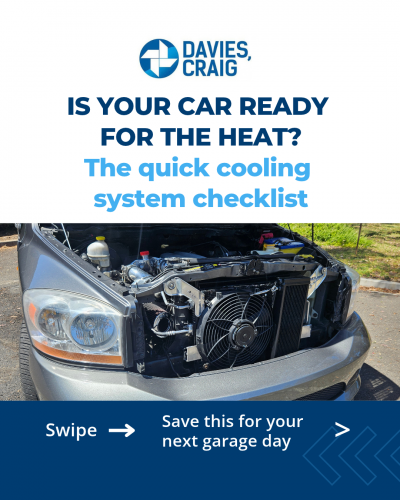
Is Your Car Ready for the Heat? The Essential Cooling System Checklist
Heat has a habit of exposing things: the hose clamp you meant to check, the coolant nobody can remember changing, and every weak point in a cooling system that seemed perfectly happy in milder weather.
Whether it’s a Gulf summer, a desert heatwave, a long highway run with a trailer behind you or stop-start traffic with the air-conditioning on full, heat makes the cooling system work much harder. A quiet inspection in the garage is a much better place to find a problem than the side of the road on a hot afternoon.
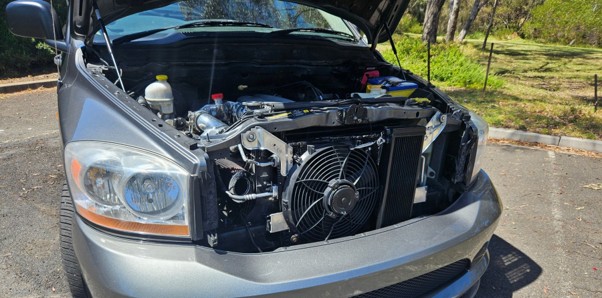
Customer build: this supercharged Dodge Ram SRT-10 runs a Davies Craig Thermatic® electric fan, controlled by a Digital Gauge Thermatic® Fan/EWP® Switch Kit (Part #0500). [Add owner credit / Instagram handle.]
THE QUICK CHECKLIST
Short on time? Check these before the hottest weather, always with the engine cold:
- Radiator and reservoir caps — seals intact, correct pressure rating
- Coolant — level, condition, correct type and mixture, service interval
- Leaks — radiator, reservoir, water pump, hoses and connections
- Hoses and clamps — no cracking, swelling or soft spots
- Radiator and coolers — fins clear of debris, sand and dust
- Drive belts — condition and tension, where fitted
- Electric fan — switches on at temperature and moves air the right way
- Wiring, fuses and relays — secure and undamaged
- Fan switch or controller — set and operating as per the instructions
Read on for what to look for, how to read the warning signs, and how to choose the right fan switch or controller.
WHAT SHOULD I CHECK FIRST?
Start with the coolant and the radiator cap, and never open either on a hot engine. The system is under pressure, and hot coolant can spray out and cause serious burns.
Follow the vehicle manufacturer’s recommendations for coolant type, mixture and replacement interval. Coolant that looks rusty, murky or oily is worth investigating. If you can’t remember when it was last changed, assume it’s due. “Sometime before the last road trip” is not quite a service interval.
The radiator cap is one of the most overlooked parts of the system. It holds the system under pressure, which raises the coolant’s boiling point. A worn or hardened seal lets that pressure escape, so the coolant boils sooner — exactly when the weather is pushing it hardest. If in doubt, replace it with a cap of the correct rating, and ask a workshop for a pressure test if you suspect a leak you can’t see.
HOW DO I KNOW IF MY HOSES AND RADIATOR NEED ATTENTION?
Inspect radiator and heater hoses for cracking, swelling, soft spots and coolant residue, particularly at hose ends, bends and clamps. On vehicles with a belt-driven water pump or fan, check belts for cracking, glazing and correct tension.
Then look at the radiator. Leaves, insects and road debris are not especially talented at heat transfer, and in desert conditions fine sand and dust can pack into the fins. Check the radiator and anything stacked in front of it, such as the A/C condenser or an oil cooler. Clean with low-pressure water or air from the engine side so the fins aren’t flattened.
WHY IS MY ENGINE RUNNING HOT?
When the temperature rises is often the best clue to why:
- Climbs in traffic or at idle, settles at highway speed: points towards airflow — the fan, its switching, the shroud or a blocked radiator. At a standstill, the fan has to do all the work.
- Climbs at highway speed, under load or towing: points towards radiator capacity, coolant flow, the thermostat or the water pump.
- Climbs quickly from cold or fluctuates: consider the thermostat, low coolant or air in the system.
These are starting points, not a diagnosis. If the gauge heads towards the red, stop safely and let the engine cool before investigating.
HOW DO I CHECK WHETHER MY ELECTRIC FAN IS WORKING?
Check the fan, shroud, wiring, fuses and relays for damage. Then, parked in a safe, ventilated place, let the engine idle up to operating temperature: the fan should switch on, bring the temperature down and switch off again. Keep hands and tools clear, as an electric fan can start without warning.
Also check it’s moving air the right way. A pusher fan sits in front of the radiator and pushes air through; a puller sits behind and draws air through. An incorrectly wired or set-up fan can run perfectly well while working against the airflow.
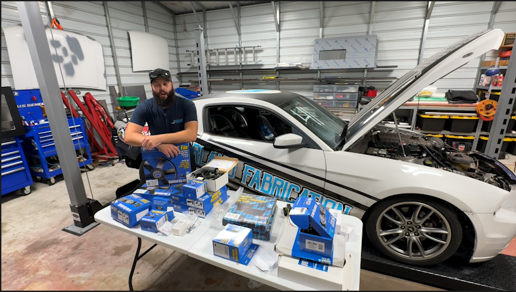
Tye Braun with his Summernats USA burnout car and the Davies Craig products going into it. High revs, extreme heat and almost no road speed: a burnout car is the ultimate test of a cooling fan. [Add video link / credit.]
DO I NEED A FAN SWITCH?
Most modern vehicles control their factory fans through the engine management system. But if you run an aftermarket electric fan — common in classics, muscle cars, hot rods, 4x4s, race cars and engine swaps — how that fan is switched is up to you. A manual switch relies on the driver watching the gauge; a temperature-based switch turns the fan on when the system needs it and off when it doesn’t.
It’s where Davies Craig started. In 1971, when belt-driven fans were the only option, Davies Craig’s founding engineers created the Thermatic® electric fan.
WHEN SHOULD AN ELECTRIC RADIATOR FAN TURN ON?
There’s no single number for every engine, but the principle is consistent: the switch-on point is typically set a little above the thermostat’s opening temperature, so the fan isn’t running unnecessarily but acts well before temperatures approach the danger zone. It then switches off a few degrees lower to avoid constant cycling. Always follow the current Davies Craig product instructions for your switch or controller.
WHICH FAN SWITCH OR CONTROLLER DO I NEED?
Start with what you’re controlling, not the most sophisticated option:
|
If you want… |
Consider |
Key details |
|
Simple, set-and-forget switching for an electric fan |
Thermatic® Fan Switch Mechanical — Part #0401 |
Adjustable 40°C to 100°C (104°F to 212°F); 12 and 24 volt |
|
Precise, push-button setting of the switch-on temperature |
Digital Thermatic® Fan Switch — Part #0480 |
Set 5°C to 110°C (41°F to 230°F); dual 40-amp relays (12V/24V) |
|
Independent settings for two fans and an Electric Water Pump, with a display |
Digital Gauge Thermatic® Fan/EWP® Switch Kit — Part #0500 |
Two fans and an EWP®; 5°C to 110°C (41°F to 230°F); 12 and 24 volt |
|
An Electric Water Pump and fans managed together |
EWP®/Fan Digital Controller Kit — Part #8003 |
Varies EWP® speed with coolant temperature and activates the fan above the set target; colour LCD |
|
Variable speed control of dual Thermatic® fans or an EWP® |
Variable Speed Controller Thermatic® Fan & EWP® — Part #0550 (Brushless) / #0555 |
Variable speed control of either dual Thermatic® fans or an EWP® |
The Dodge Ram SRT-10 pictured above, for example, uses the #0500 to control its Thermatic® fan.
A few minutes in the garage now can save a considerably less enjoyable inspection later — usually when it’s hotter, less convenient and someone has already asked, “Wasn’t that temperature gauge a bit high?”
CTA (primary): Running an aftermarket electric fan or EWP®? Compare the Davies Craig range of Thermatic® fan switches and controllers. Fan Switches & Controllers
CTA (secondary): Find current product instructions and installation videos. Product Instructions / YouTube
Cooling-system requirements vary by vehicle and application. Follow the vehicle manufacturer’s service information and current Davies Craig product instructions, and seek appropriate technical advice where required.